|
☰ Menu
| The Aurora Forecast |
Quick links:
|
Description
|
3-Day
|
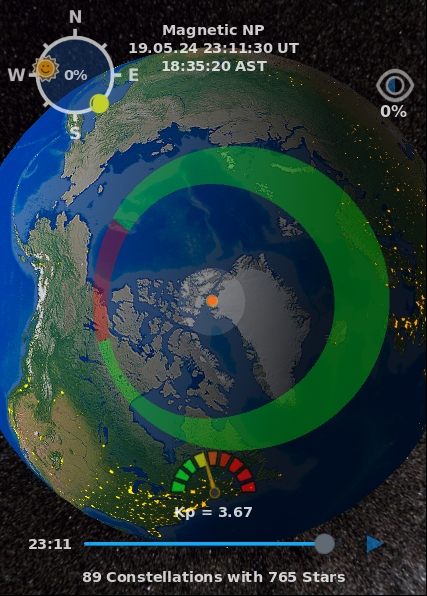
3D| First view: Planetary auroral oval with NOAA 3-day Kp forecast.
Next views: Local oval and sky view as seen from 12 preselected sites.
Space weather conditions
How to hunt for the aurora?
For most people on Earth, you will have time to eat dinner. Then check your local weather forecast for clear skies. Download the Aurora Forecast 3D app or Rocketeer version of it for your mobile phone. Run it and locate the auroral oval. If you have a clear view of the oval above your head, seen in the Aurora Compass, then you have up to 75% chance to see the aurora. Happy hunting!
Travel tip
First, locate a city or an airport above the Arctic Circle. Secondly, remember that it has to be dark. The Sun needs to be ~10 degrees below the horizon. Otherwise, the aurora will be drowned in solar light. In the northern hemisphere, this means late autumn to early spring with best viewing conditions during the late afternoon and into the night. Thirdly, we recommend a location where there is stable cold in-land climate during the winter. For example, Fairbanks in Alaska or Alta in Norway are excellent locations. Another option is to take a boat trip and hunt for clear skies.
Recommended reading: Aurora Field Guide and Handbook for Citizen Science
A short description of the Aurora Forecast
The above images are generated by our aurora forecast app. They are updated every 15 minutes.
Left image shows the size and location of the impact zone of energetic particles from the Sun,
i.e. a green circular belt of auroral emissions around each geomagnetic pole.
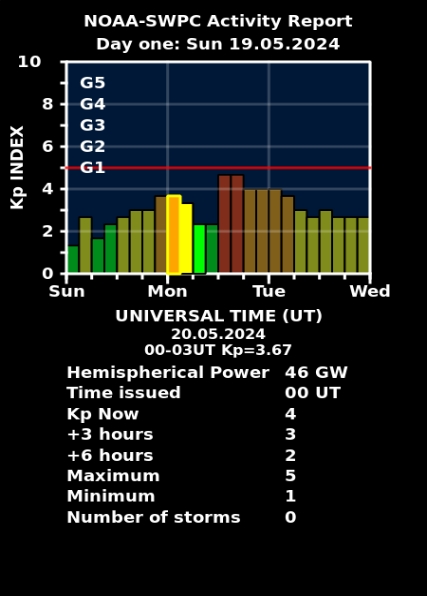
These belts are known as the auroral ovals. Right image shows the Space Weather
Prediction Centre (
NOAA-SWPC)
3-day Kp forecast. Next sequence shows a zoomed in view of the oval at 11 preselected sites with the
local all-sky view as seen from the ground. Sun, moon, planets and star poistions are
also inluded.
The relationship between the morphology of the auroral oval and the level of
geomagnetic activity allows us to develop models of the location of the aurora,
independent of the vagaries of auroral observations.
The methods by Starkov (1994) and Zhang and Paxton (2008) are used to mathematically
calculate the size and location of the auroral ovals mapped onto a solar illuminated Earth globe.
In addition, a new oval model is implemented that use data of particle precipitation measured
by polar orbiting satellites (M. J. Breedveld, 2020).
The models only use the planetary Kp index and time as input, which makes them ideal candidates
for forecasting aurora. The predicted Kp value is estimated by NOAA-SWPC
using satellites that are located upstream in the solar wind (Sigernes et al. 2011a; 2011b).
Note that the prediction time depends data availability.
Mobile phone solutions
Generation 1 - (Obsolete)
An old app was available to the public for free and worked on any phone. The original android app was updated and converted by the company Appex.no back in 2012 to work on
iPhone and Windows phones. It was available through Windows Market Place, Apple App Store and Google Play.
Name of old mobile app was:
"Auroral Forecast"
Cross - platform solutions
Generation 2
The Aurora Forecast 3D app was first published in 2017 on Google Play for android phones (version 4.0 and up), Windows (32/64-bit) and Apple OSX.
In 2020 it also became avaliable for Linux - Ubuntu. The app forecasts the aurora oval up to 3 days ahead in time
at any location on the planet using a 3D graphical layout.
Name of app is: "Aurora Forecast 3D"
More info and download links are found here.
Generation 3
Based on user feedback a new simplified version of the forecast named Rocketeer was published in July 2023. The aim is to provide an easy-to-use app with focus on auroral forecasting using only your phone location sensor. A new feature was also added to conduct virtual space travel by rocket to other planets in the solar system. Note that the old 3D app will still be updated.
Name of app is: "Aurora Forecast Rocketeer"
More info and download links are found here.
Generation 4 - under development
Due to high costs and developer administration, a new attempt is under way to transfer the app to HTML5. With this approach no developer account at Apple or Google is needed to make the app available on all platforms. Publishing and updates becomes much faster to carry out.
The present work is based on the JavaScript 3D library Three.js from https://threejs.org and lessons therein. It also uses the excellent Astronomy-Engine from https://github.com/cosinekitty/astronomy.
The app is under construction here:
https://kho.unis.no/AuroraForecastJS/
References
M. J. Breedveld, Predicting the Auroral Oval Boundaries by Means of Polar Operational Environmental Satellite
Particle Precipitation Data, Master thesis, Department of Physics and Technology, Faculty of Science and Technology,
The Arctic University of Norway, June 2020.
F. Sigernes, M. Dyrland, P. Brekke, E. K. Gjengedal, S. Chernouss, D. A. Lorentzen,
K. Oksavik and C. S. Deehr, Real time aurora oval forecasting - SvalTrackII,
Optica Pura y Aplicada (OPA), 44, 599-603, 2011a.
F. Sigernes, M. Dyrland, P. Brekke, S. Chernouss, D.A. Lorentzen, K. Oksavik, and C.S. Deehr,
Two methods to forecast auroral displays, Journal of Space Weather and Space Climate (SWSC),
Vol. 1, No. 1, A03, DOI:10.1051/swsc/2011003, 2011b.
Starkov G. V., Mathematical model of the auroral boundaries, Geomagnetism and Aeronomy, 34 (3), 331-336, 1994.
Zhang Y., and L. J. Paxton, An empirical Kp-dependent global auroral model based on TIMED/GUVI data,
J. Atm. Solar-Terr. Phys., 70, 1231-1242, 2008.
Acknowledgement
We wish to thank the National Oceanic and Atmospheric Administration (NOAA) -
Space Weather Prediction Centre for allowing us to download the predicted value
of the estimated Kp index. The work is financially supported
by The Research Council of Norway through the project named: Norwegian and
Russian Upper Atmosphere Co-operation On Svalbard part 2 # 196173/S30 (NORUSCA2),
the Nordic Council of Ministers: Arctic Cooperation Programme # A10162,
and COST action ES0803.