The University Centre in Svalbard (UNIS), Norway
1 Statsbygg Region North Svalbard, Norway
| ©KHO Created 16.01.2026 - Revised: 09.03.2026 |
The observatory continues a legacy of auroral research that began at the original Nordlysstasjonen in Adventdalen (1978-2007). On February 18, 2026, the observatory will mark 18 years since its official opening by the Minister of Research and Higher Education, Tora Aasland, together with astronaut Christer Fuglesang.
Her Majesty Queen Sonja of Norway honored the observatory with visits in both 2013 and 2015 - events we remain deeply grateful for and proud of.
| Daily Operations |




| Scientific personnel |







| Name | Position | |
| Daily operations | ||
| Fred Sigernes | Prof. Optics and Atmospheric Research / Chief KHO / Adjunct Prof. NTNU | |
| Mikko Syrjäsuo | Department Engineer KHO / OFS | |
| Ida Elen Asklund | Operations Manager Statsbygg | |
| Kjell Ivar Haugnes | IT Manager UNIS / KHO | |
| Alexander Eskedal | Technician - Motorhead UNIS / OSF | |
| SuperDARN | ||
| Dag Arne Lorentzen | Prof. Arctic Geophysics (PI) | |
| Lisa Baddeley | Prof. Space physics - Radar applications (Co-I) | |
| Scientists / Lecturers | ||
| Noora Partamies | Prof. Middle Atmos. Physics | |
| Katie Herlingshaw | Researcher Upper Atmos. Physics | |
| Nina Kristine Eriksen | PhD. Candidate Space Physics | |
| Charlotte van Hazendonk | PhD. Candidate Space Physics | |
| Lena Mielke | PhD. Candidate Space Physics | |
| Stein Haaland | Department Leader Geophysics | |
| Adjunct Professors | ||
| Kjellmar Oksavik | Adjunct Prof. Space Physics | |
| Pål Brekke | Adjunct Prof. Solar Physics |
Table 1. The KHO crew (2025). SuperDARN is abbreviation for the Super Dual Auroral Radar Network radar in Longyearbyen, while OFS means the Operations and Field Safety department at UNIS.
The current KHO team is listed above. Fred Sigernes serves as Head and shares daily operational responsibilities with Mikko Syrjäsuo. Ida Elen Asklund, from the Norwegian Construction and Property Management Department (Statsbygg) in Longyearbyen, is our primary contact for building ownership matters. Kjell Ivar Haugnes provides IT support for the observatory. Alexander Eskedal has maintained our bandwagon and cars.
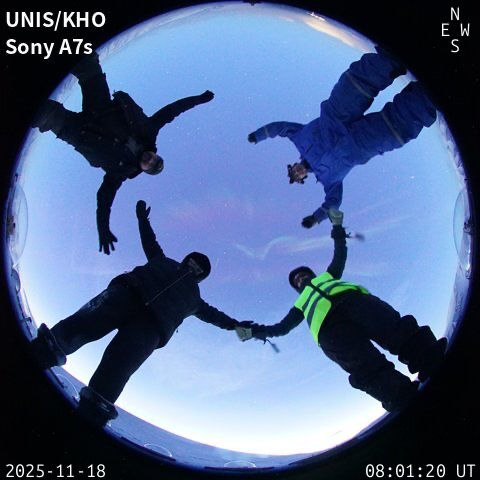
Fig. 1. RENU-3 students together with operation personnel posing in front of the Sony A7s All-Sky camera.
Table 2 lists 6 relevant courses in space physics and instrumental techniques tied to the observatory. A grand total of 45 ECTS (European Credit Transfer and Accumulation System) was available to the students.
| Code | Course name | ECTS |
| AGF-216 | The Stormy Sun and the Northern Lights | 5 |
| AGF-345/845 | Polar Magnetospheric Substorms | 10 |
| AGF-210 | The middle polar atmosphere | 15 |
| AGF-223 | Remote sensing and space instrumentation | 15 |
Table 2. Courses in (2025). Strikeout courses are due to key personnel were on sabbatical leave.
The UNIS Svalbard history course is closed. AGF-216 has therefore become mandatory for Arctic Nature Guide (ANG) students. As a result, a record number of students, close to 100, visited the observatory.
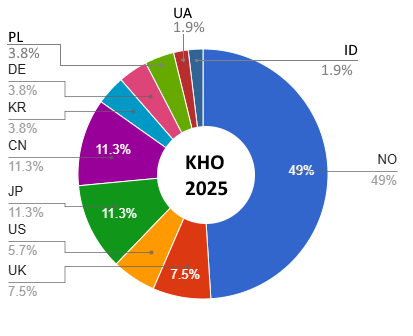
23 different institutions from 10 nations are present at KHO.
| # | Institution | Country | Code | Instruments |
| 1 | University Centre in Svalbard (UNIS) | Norway | NO | 18 |
| 2 | UiT-The Arctic University of Norway | Norway | NO | 3 |
| 3 | University of Oslo (UiO) | Norway | NO | 2 |
| 4 | University of Bergen | Norway | NO | 1 |
| 5 | NORSAR | Norway | NO | 1 |
| 6 | Kongsberg Satellite Service AS | Norway | NO | 1 |
| 7 | Augsburg College | USA | US | 1 |
| 8 | University of New Hampshire | USA | US | - |
| 9 | University of Colorado Boulder | USA | US | 1 |
| 10 | New Jersey Institute of Technology | USA | US | 1 |
| 11 | University College London (UCL) | England | UK | 3 |
| 12 | University of Southampton | England | UK | 1 |
| 13 | National Inst. of Polar Research (NIPR) | Japan | JP | 3 |
| 14 | Kyoto University | Japan | JP | 2 |
| 15 | Tohoku University | Japan | JP | 1 |
| 16 | Polar Research Inst. of China (PRIC) | China | CN | 6 |
| 17 | Korea Polar Research Institute | Korea | KR | 2 |
| 18 | Institute of Radio Astronomy | Ukraine | UA | 1 |
| 19 | Polish research base Hornsund | Poland | PL | 1 |
| 20 | Sybilla Technologies | Poland | PL | 1 |
| 21 | National Institute for Aeronautics | Indonesia | ID | 1 |
| 22 | Technische Universitat Berlin (TU) | Germany | DE | 1 |
| 23 | German Aerospace Center (DLR) | Germany | DE | 1 |
| Total: | 10 | 53 |
Table 3. Groups and number of instruments in 2025 .
The instruments at KHO are grouped into mainly five categories (##):
- (A) All-sky cameras and narrow field of view imagers
- (B) Meridian scanning photometers
- (C) Spectrometers / Spectrographs
- (D) Scanning / imaging interferometers
- (E) Radio or non-optical instrument
A detailed description of the performance and the scientific objective of each instrument are found below.
| No. | Instrument | Institution | ## | Code |
| 1 | All-Sky Imager | University of Oslo (UiO) | A | NO |
| 2 | All-Sky Video Camera | University Centre in Svalbard (UNIS) | A | NO |
| 3 | All-Sky Colour Imager | University College London (UCL) | A | UK |
| 4 | BACC All-Sky Color Camera | UNIS | A | NO |
| 5 | Sony A7s All-sky Camera | UNIS | A | NO |
| 6 | All-Sky Airglow Camera | UNIS | A | NO |
| 7 | Auroral Spectrograph | National Inst. of Polar Research (NIPR) | C | JP |
| 8 | NIR Spectrograph | NIPR | C | JP |
| 9 | NIR Camera | NIPR | A | JP |
| 10 | Spectrographic Imaging Facilities | University of Southampton | C | UK |
| 11 | Meridian Scanning Photometer | UNIS | B | US/NO |
| 12 | 1/2m Black Ebert-Fastie | UNIS | C | US/NO |
| 13 | 1/2m White Ebert-Fastie | UiT-The Arctic University of Norway | C | NO |
| 14 | 1m Silver Ebert-Fastie | UNIS | C | US/NO |
| 15 | 1m Green Ebert-Fastie | UNIS | C | US/NO |
| 16 | Fabry-Perot Interferometer | UCL | D | UK |
| 17 | Scanning Doppler Imager | UCL | D | UK |
| 18 | Monochromatic Auroral Imager | Polar Research Inst. of China (PRIC) | A | CN |
| 19 | Single-wave Auroral Imager | PRIC | A | CN |
| 20 | Fabry-Perot Interferometer | PRIC | D | CN |
| 21 | All-Sky Airglow Imager | Kyoto University | A | JP |
| 22 | Hyperspectral tracker | UNIS | C | NO |
| 23 | All-Sky hyperspectral camera | UNIS | C | NO |
| 24 | Celestron 14" Telescope | UNIS | A | NO |
| 25 | Narrow field of view sCMOS tracker | UNIS | A | NO |
| 26 | MISS 1 | UNIS | C | NO |
| 27 | MISS 2 | UNIS | C | NO |
| 28 | The Hot Oxygen Doppler Imager | New Jersey Institute of Technology | D | US |
| 29 | Boreal Auroral Camera Constellation | UNIS | A | NO |
| 30 | Fluxgate Magnetometer | UiT | E | NO |
| 31 | 2-axis Search-coil Magnetometer | Augsburg College and University of New Hampshire | E | US |
| 32 | 64-beam Imaging Riometer | UiT | E | NO |
| 33 | Auroral Radio Spectrograph | Tohoku University | E | JP |
| 34 | HF acquisition system | Institute of Radio Astronomy / UiT | E | UA |
| 35 | Scintillation and TEC receiver | University of Bergen | E | NO |
| 36 | Fluxgate Magnetometer | PRIC | E | CN |
| 37 | Induction Magnetometer | PRIC | E | CN |
| 38 | Polar Research Ionospheric Doppler Experiment | UNIS/Polish research base Hornsund | E | PL/NO |
| 39 | UCB-GNSS receiver | University of Colorado Boulder | E | US |
| 40 | Receiver station for Weak Signal Propagation Reporter (WSPR) | UiO | E | NO |
| 41 | Aurora All-Sky Camera | Korea Polar Research Institute (KOPRI) | A | KR |
| 42 | Fabry-Perot Interferometer | KOPRI | D | KR |
| 43 | Rowe-Ackermann Schmidt Astrograph | Sybilla Technologies | A | PL |
| 44 | Induction Magnetometer | Kyoto University | E | JP |
| 45 | Outdoor All-Sky Camera unit | PRIC | A | CN |
| 46 | 2 x Tracker cameras | UNIS | A | NO |
| 47 | Internet radio link-Janssonhaugen | NORSAR | E | NO |
| 48 | UHF Ground station | National Institute for Aeronautics | E | ID |
| 49 | UHF Ground station | Technische Universität Berlin | E | DE |
| 50 | Riometer - 2xGNSS antennas | German Aerospace Center | E | DE |
| 51 | VHF base station | Kongsberg Satellite Service AS | E | NO |
| 52 | Automatic weather station | UNIS | E | NO |
| 53 | WEB cameras (safety) | UNIS | A | NO |
Table 4. Instruments at KHO (2025).
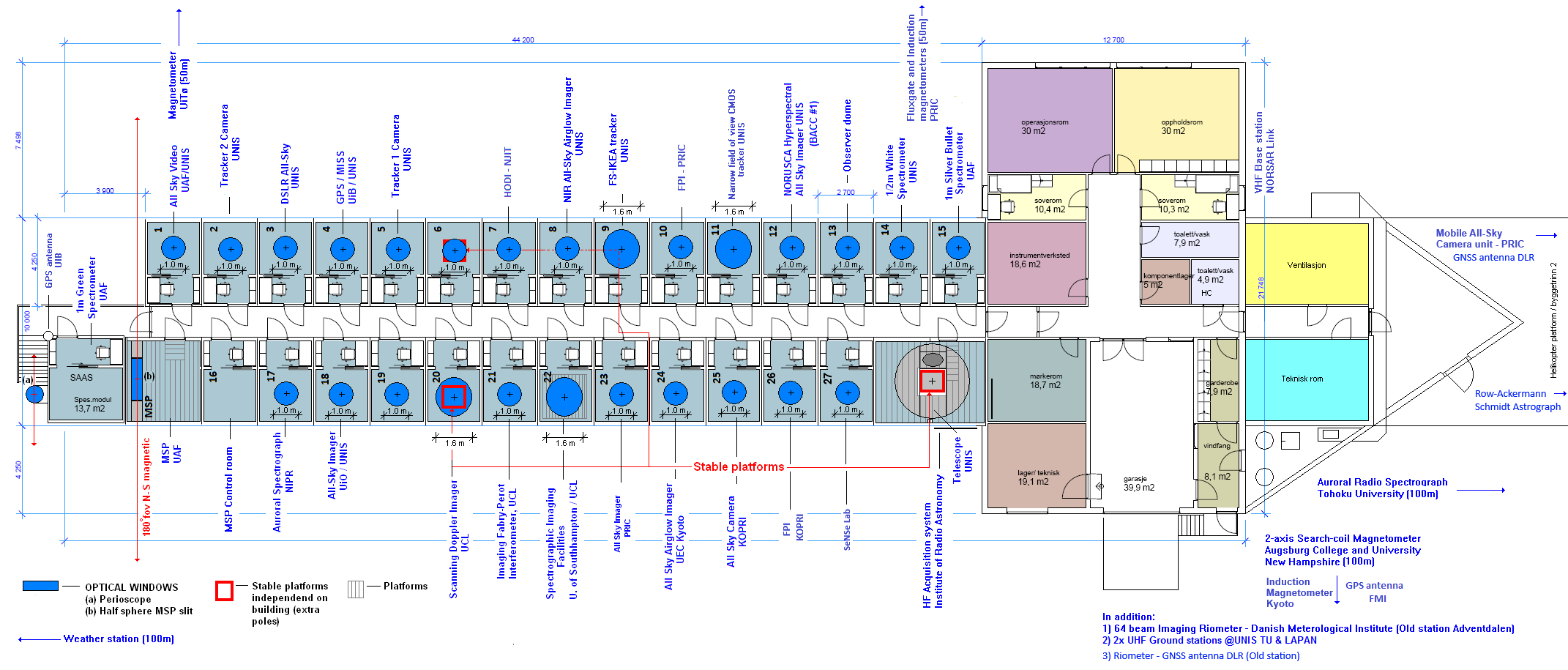
Figure 3 shows a map of where the instruments are located. Tables 3-4 lists all according to institution and category (##). Note that out of 30 instrument domes; 2 are currently not in use.
The Principal Investigators (PIs) of each instrumental group have been informed that the instrumental fee will be adjusted on a yearly base according to the Consumer Price Index (CPI) from Statistics Norway and any adjustments imposed by the owner Statsbygg - the Norwegian government building commissioner at Svalbard. The fee is now 26k NOK for 2026.
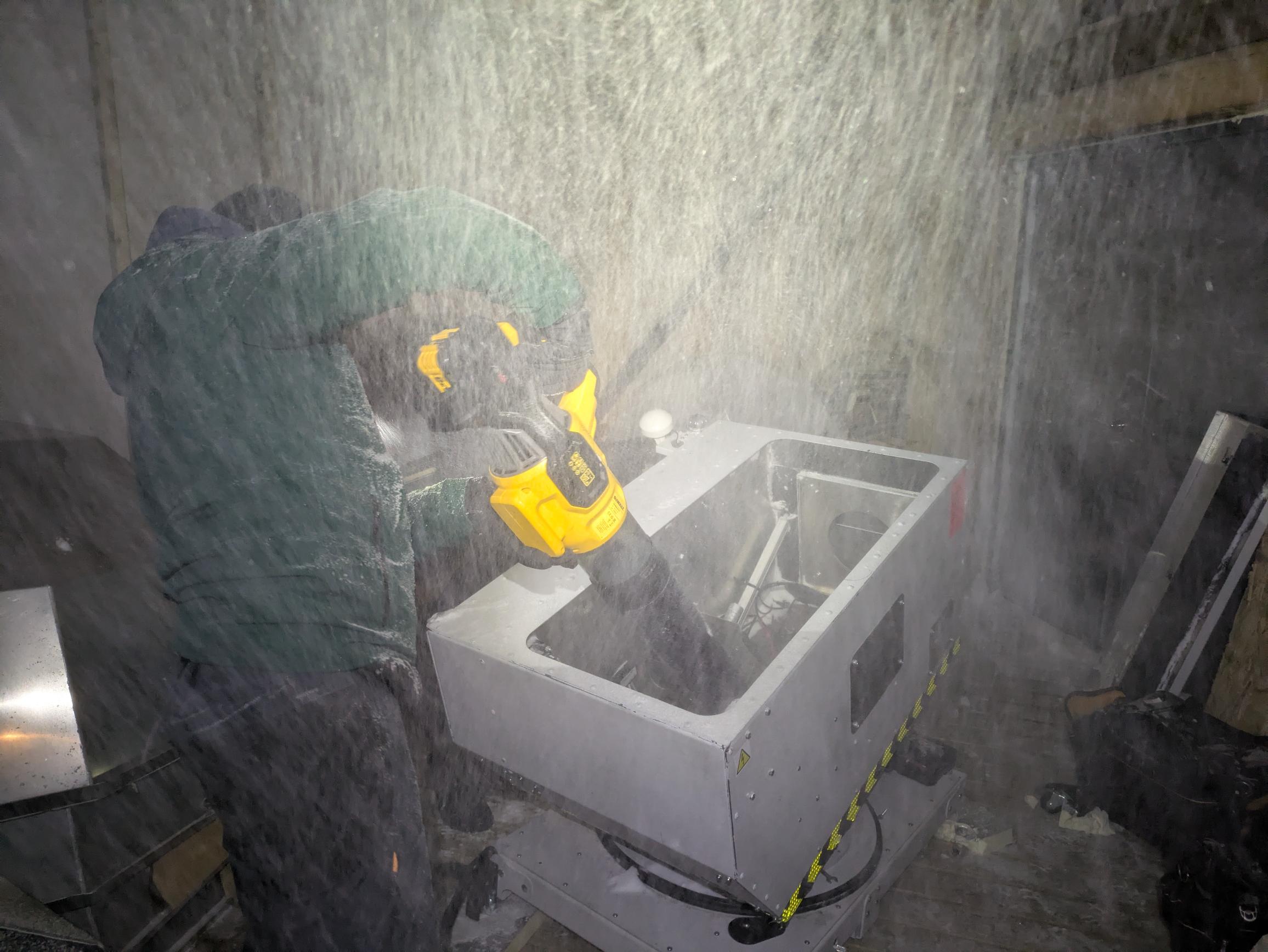
This autumn, a water pump failure caused a significant freshwater leak in the tank room, necessitating removal of insulation and base plates to allow the floor to dry. Additionally, one heat pump in the battery room is suspected to have been damaged during a snowstorm after the platform door failed last season. The door has since been replaced with a metal one. Several ventilation fans require servicing due to excessive noise, likely caused by worn bearings, and door handles have been replaced.
The most costly upgrade will be the replacement of the UPS, which has reached end-of-life and suffers from limited spare parts availability. Copper water pipes should also be replaced with stainless steel.
The new network switches and virtual servers are finally installed and operational after 2 years of configuration and testing. The network should now be up to date and secure according to Norwegian university standards.
Other minor repairs remain including the emergency lighting system, repainting interior doors, servicing the main entrance key code unit, and replacing the metal plate on the entrance bridge, which was damaged by a snow-clearing machine.
High on the priority list is the installation of an emergency generator to protect the battery bank from complete discharge during unexpected external power outages.
 |
Is the Aurora disappearing from Svalbard?
Mikkel Breedveld and Stein Haaland points out that the magnetic pole moves in position and will consequently shift the
auroral oval 5-6 km South each year if the current changes in the Earth's magnetic field continues.
The question of how long we will see aurora from Svalbard is raised.
Read Svalbardposten feature article. 30 January, 2025
|
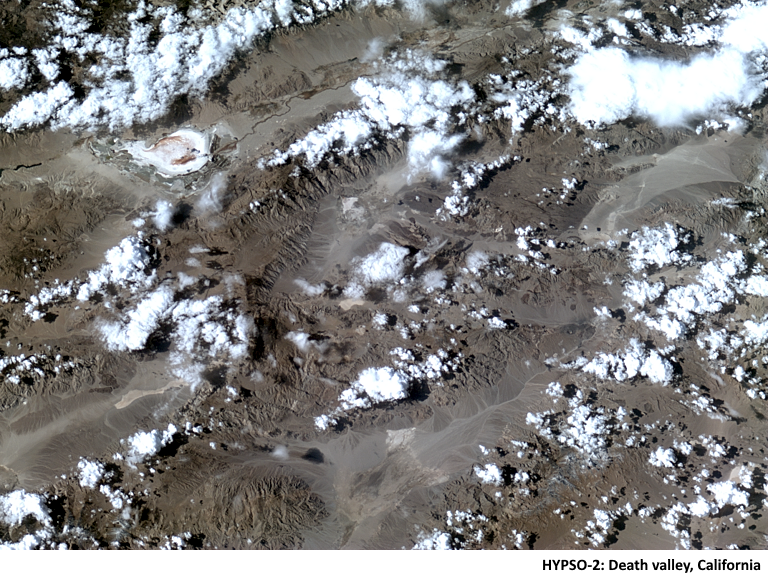 |
HYPSO-2 works!
We are proud to report that the HYPSO-2 satellite works as planned with sharp focus on both camera systems. The improved payload consist of our designed Hyper Spectral Imager (HSI v6) and a regular RGB camera.
See stunning images in Gemini.no 31 January, 2025
|
 |
Observatory science highlights!
Read Katie Herlingshaw et al. (2025) extensive publication in the Journal Arctic Science on KHO highlights. A historic compilation that spans over 4 decades from the old Nordlysstasjonen in Adventdalen (1978) and up until today. Well done, Katie!
Read milestone paper. 3 February, 2025
|
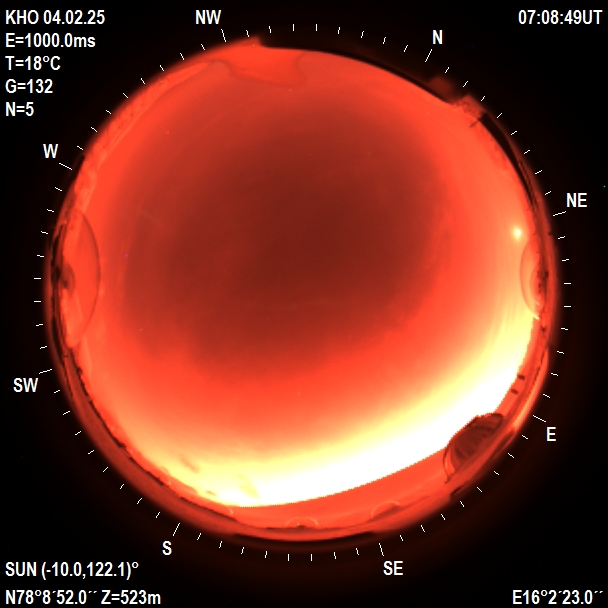 |
The Red-Sky Enigma returns
From mid-January with the return of nautical to civil twilight conditions on Svalbard, a red-purple sky color
is daily observed with the rise of the Sun - even though it's way below the horizon. This effect is due to a long period of cold temperatures
(-85oC)
in the Stratosphere over Svalbard and the mainland. As a consequence, Polar Stratospheric Clouds (PSC) are formed, ducting and scattering the solar light
into the dark illuminated polar hemisphere. The process is explained in our Red-Sky Enigma paper published back in 2005.
Read paper here. 4 February, 2025
|
 |
New prototype published!
Our prototype Near-Infra Red Hyper Spectral Imager version 7 (NIR HSI v7) is now published in the journal Optics Continuum (Optica). The instrument is assembled using 3D printing.
Furthermore, it uses a new novel high speed Black Silicon CMOS image sensor.
Read paper here. 12 February, 2025
|
 |
Kjellmar in Space?
View video snap of our Prof. II Kjellmar Oksavik on TV2 Play. He is dressed in a space suit for the event, explaining why we have high auroral activity the next couple of years. Excellent, Kjellmar!
See video here. 13 February, 2025
|
 |
Podcast: Norways Sol-Pål!
Listen to Norwegian podcast on Spotify with our Prof. II Pål Brekke. Here he small talks about the Sun, Aurora, KHO, AGF-216, belt wagons and other space activities on Svalbard. Lots of topics are covered, even Karlsberger pub.
Romkapsel podcast: Episode 275. 16 February, 2025
|
 |
BBC radio visit
Listen to BBC CrowdScience episode titled: Why isn't the sky green? Katie Herlingshaw explained the sky colors and scattering.
She also guided the crew for an excursion up to the observatory. Well done, Katie!
Listen here. 21 February, 2025
|
 |
Asteroid impact?
Prof. II Kjellmar Oksavik strikes again on TV2 Play TikTok! He informs that the asteroid identified as 2024 YR4 discovered last Christmas, will according to calculations by NASA, luckily not hit Earth in 8 years. That is a great relief!
See TV2 TikTok. 25 February, 2025
|
 |
NEW Planeterrella!
Olivier Katz and Baptiste Falque from the University of Grenoble have installed and demonstrated our new
Planeterrella reconstructed by Prof. Jean Lilensten. It's capable of creating artificial aurora just like Kristian Birkeland did back at the turn of the 19th century.
View amazing displays recorded by Lotte van Hazendonk in the below links.
Images [ 1, 2, 3, 4] and movies [ 1, 2, 3] 5 March, 2025
|
 |
Fram2 mission complete!
Fram2 astronauts including Norway's first vehicle commander Jannicke Mikkelsen have teamed up with UNIS space physicists.
The mission is the first human manned polar orbit commercial spaceflight. The SolarMaX citizen scientist
project are supporting the mission with simultaneous auroral ground data.
Fram2 was successfully launched at 01:46 UTC on Tuesday 1st of April 2025 from Kennedy Space Center in Florida. The mission is complete and splashdown was today at 16:19 UTC. Congratulation to Jannicke and her team! Read the latest SolarMaX updates here. 4 April, 2025
|
 |
Spotlight on Optics!
Eureka! The Optica Publishing Group has chosen our paper: Near infra-red black silicon pushbroom hyperspectral imager, for inclusion in Spotlight on Optics.
Read the summary here. 9 April, 2025
|
 |
Australia joins KHO!
We are proud to announce that Western Sydney University (WSU) has joined the observatory. Dr. Greg Cohen and his team from the International Centre for Neuromorphic Systems (ICNS) are experts in event-based camera sensors. We look forward to co-operate and test the new technology on both aurora and on our hyperspectral cameras.
Visit ICNS. 14 April, 2025
|
 |
Government white paper
The Norwegian government white paper on Svalbard (2023-2024) recognizes our activity on Breinosa as a world-leading space weather infrastructure. See textbox 4.4 in Chapter 4. We are happy together with our partners for this recognition and will continue to serve and improve our aurora forecasts to the public.
Read white paper here. 19 May, 2025
|
 |
Fond memories 80's
Today we received a history preview from Dr. Nick Lloyd from the University of Saskatchewan in Canada of
the Auroral station in Adventdalen. The panorama dates to the winter season 1982/83...
Read more here. 3 June, 2025
|
 |
White aurora!
Continuum emission has been observed embedded in the dayside aurora over Svalbard.
It is a broadband emission that looks nearly white in the full-colour all-sky images, while the spectrographs see an enhancement
in the whole wavelength range from 400 to 700 nm. The continuum emission structures move and evolve with the aurora, and are
associated with both plasma and neutral heating. This may be a more dynamic cousin of STEVE ...
Read paper here and Noora's UNIS report. 3 July, 2025
|
 |
Coming up!
KHO is part of the upcoming NASA sounding rocket campaign named Rocket Experiment for Neutral Upwelling 3 (RENU-3). The payload is designed to measure neutral gas, ions and electrons
associated with Poleward Moving Auroral Forms (PMAFs) in the dayside Cusp. The first possible launch window is 13 - 27 of November. PI is Prof. Marc Lessard from University of New Hampshire (UNH).
AGU abstract. 11 August, 2025
|
 |
Press release Andøya Space. 23 November, 2025
|
 |
New BACC all-sky camera at Alomar!
Our Boreal Aurora Camera Constellation (BACC) is slowly expanding in size since we started it back in 2015.
The constellation has a low-cost philosophy with minimum administrative oversight and load.
Camera number 6 is now installed at the Alomar Observatory operated by Andøya Space.
We now cover northern Scandinavia and Svalbard with real-time all-sky views of the auroral oval. Data is used to improve our auroral forecast capability. See cameras field of view (coverage).
Read details here. 10 December, 2025
|
The BACC constellation, highlighted earlier, has now expanded to six stations. Figure 5 illustrates example data: while Svalbard experiences cloud cover and significant light pollution, stations in Northern Scandinavia capture simultaneous auroral observations from multiple viewpoints with one-second time resolution.
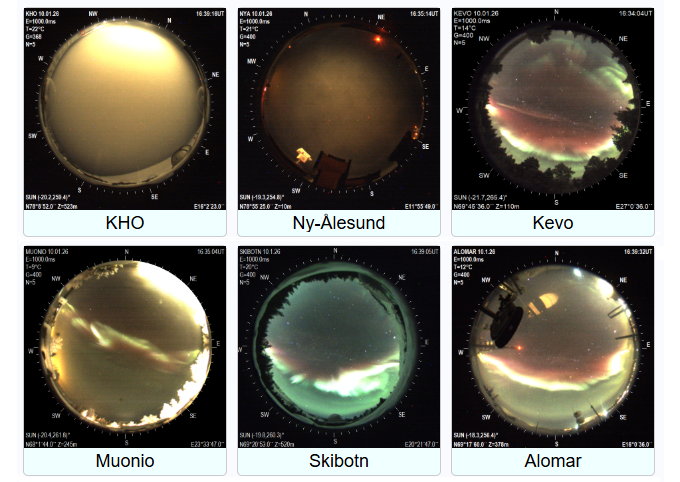
The all-sky camera constellation functions as a high-speed optical radar, capable of mapping aurora and other illuminated or self-emitting objects in the sky, provided conditions are clear. This system is essential for advancing our auroral forecast models and demonstrates how KHO's expertise in instrumentation can be successfully exported and applied beyond our observatory.
An assembled and calibrated BACC camera is an excellent gift to give partners with auroral infrastructure, offering auroral imaging capabilities at very low operational cost, expanding the constellation.
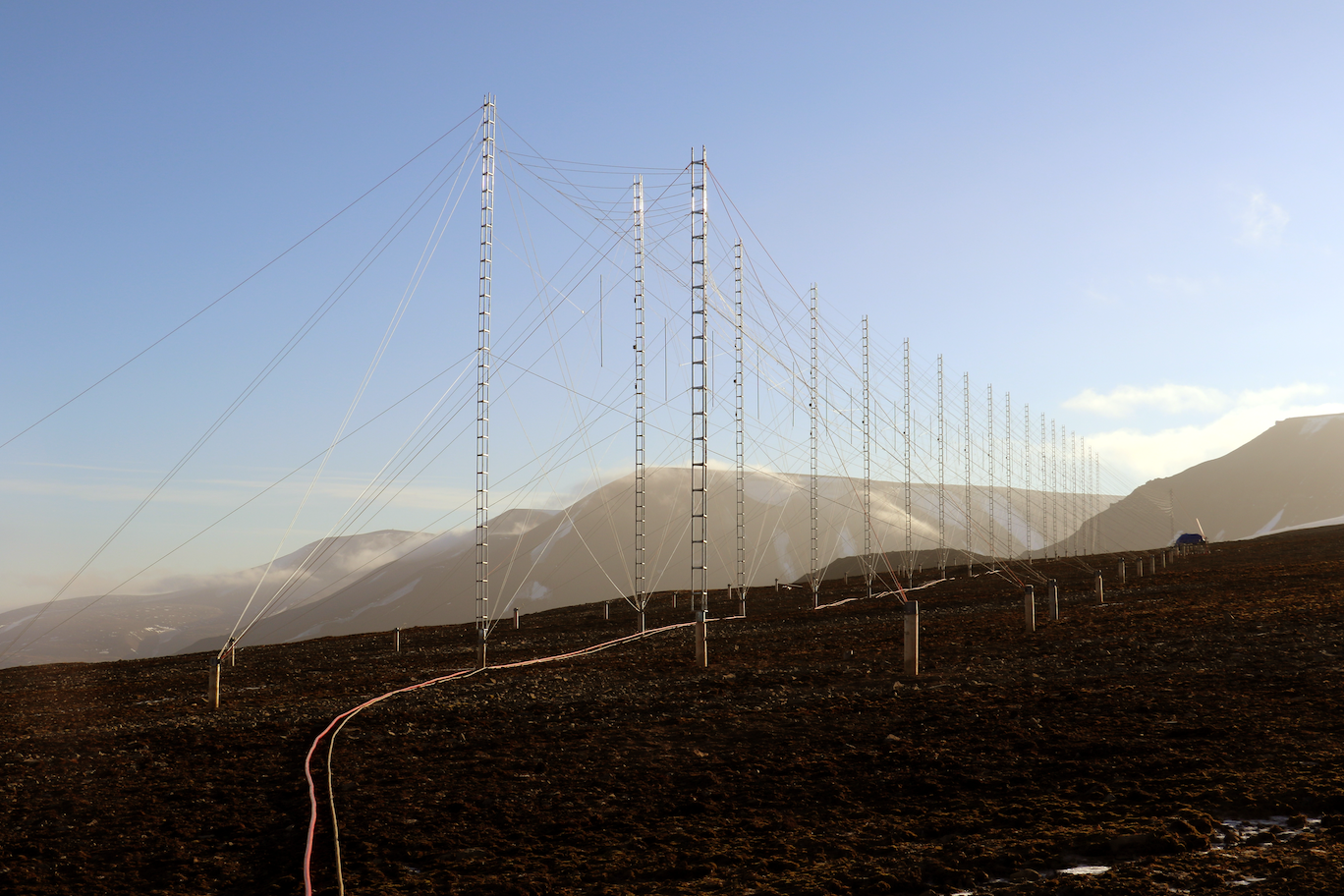
The LYR SuperDARN radar is currently in full operation and running nominally 24/7. Since the radar data became publicly available in December 2024, the radar has been operational without any major issues, except from a few days unscheduled power cuts due to issues outside our control. See quick look data here.
Some maintenance work has been done on the radar system during 2025, including main- and offset calibrations, as well as tightening of the guy ropes for all antenna masts. In addition, a new airport interlock system was installed (this is a mandatory system that turns off the radar when airplanes cross the field-of-view of the radar), and a new UPS system has been purchased and installed as well.
UNIS has signed a Memorandum of Understanding (MoU) with partners in Italy, and Norway. It was signed at the Italian Embassy in Oslo in May.
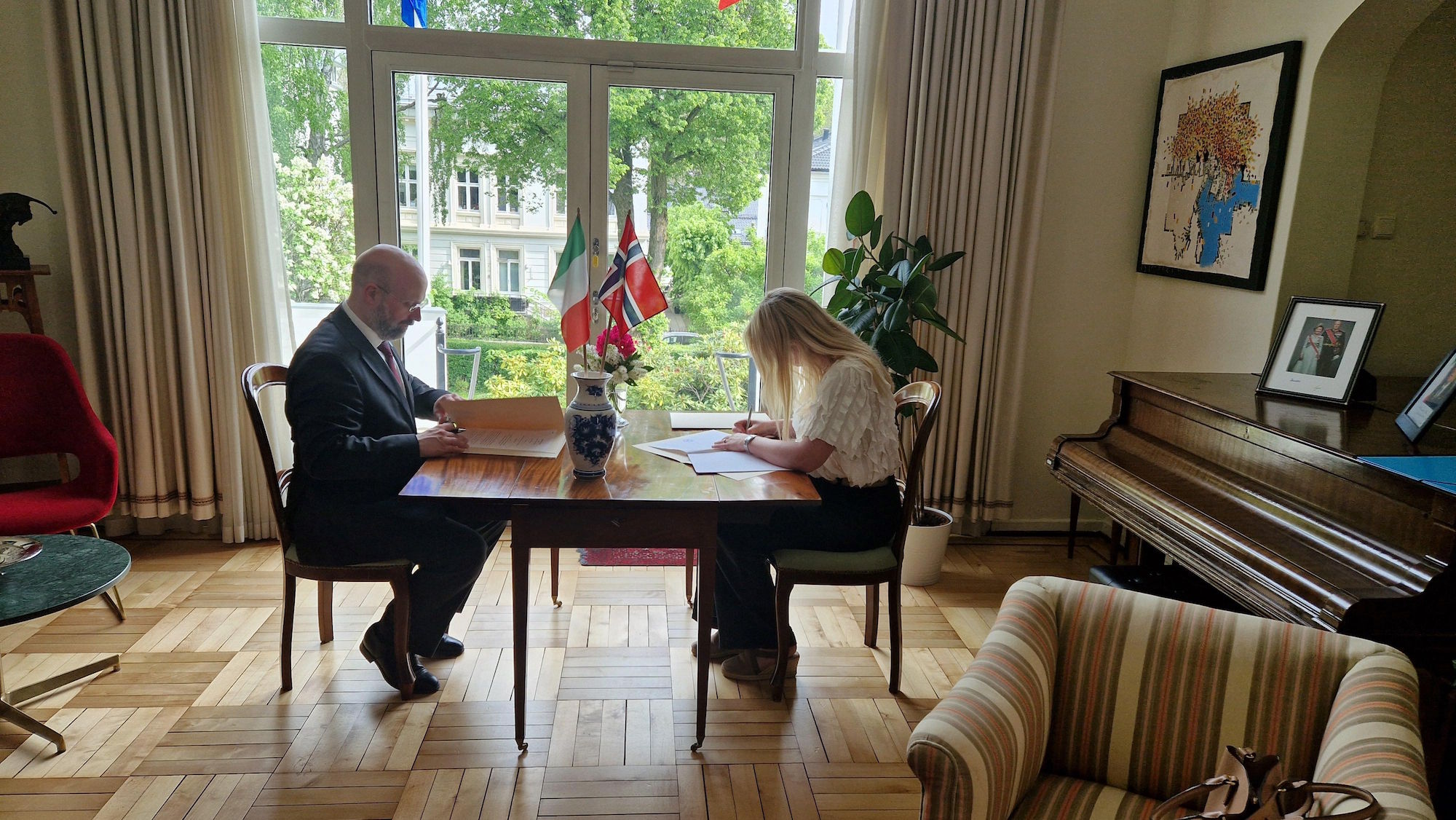
UNIS has expertise in operating and managing space weather instrumentation on Svalbard and this is an excellent opportunity to extend our collaborations into another dimension of space weather observations; by observing the Sun directly. Along with our Norwegian colleagues at UiO and UiT we are very excited to be part of this project. More info here.
In June, the University of Tromsø (UiT) visited KHO, bringing guests from the leaderships of the Norwegian youth parties. The visit was part of the annual cruise with RS Helmer Hansen, where decision makers and politicians are taught about Svalbard in terms of nature, climate and geopolitics. The event was organized to emphasize the importance and uniqueness of infrastructures in Adventdalen to study geospace for both space physics and space weather.
Purpose
The Kjell Henriksen Observatory (KHO) is dedicated to studying processes in the magnetospheric cusp and across the polar cap boundary. Our core mission is to understand the effects of solar-magnetospheric interactions on Earth's atmosphere. Leveraging our unique location and advanced multi-disciplinary infrastructure - including radars and optical systems - we can observe the entire atmospheric vertical column, providing critical insights into space and planetary weather.
Goals
- Instrumental Development: Continuous upgrading and comparison of instruments as new technologies and knowledge emerge.
- Collaboration: Strengthen partnerships with existing research groups and attract new collaborators.
- Campaign Participation: Position the observatory as a leading partner for large-scale rocket and satellite missions, both instrumentally and observationally.
Access to internal UNIS research funding is vital and important for:
- Preserving instrumental momentum.
- Tracking and integrating emerging technologies.
- Seeding research plans and proposals.
Research rockets are also launched from Svalbard to study space weather and other unique Arctic atmospheric phenomena. The Svalbard Rocket Range (SvalRak) is a launch site for research rockets near Ny-Ålesund. SvalRak is owned by Andøya Space AS, a state-owned company under the Ministry of Trade, Industry and Fisheries."
We are happy together with our partners for this recognition and will continue to serve and improve our aurora forecasts and data to the public.
Today, we depend on access up the mountain and a garage that we hire at Mine 7 for the bandwagon. The maintenance cost of the road up the mountain was estimated during a meeting in November with SNSK and the other users of the mountain: UNIS, KHO, SuperDARN and EISCAT. The results has been reported to our politicians for a final decision. Alternatives, if the road is abounded, are listed in previous yearly reports, and will not be repeated here.
The second battle is light pollution. After consultation with Visit Svalbard, it was recommended that we apply dialog instead of confrontation in the media. As a consequence, an on-line meeting was arranged with the dog yards to address possible solutions. But no one turned up to the meeting! Nevertheless, we discussed with Visit Svalbard possible solutions including shielding of outdoor lamps and power OFF during the night and early morning, when the dogs should sleep. To our pleasant surprise, this tactic was applied during the RENU-3 rocket campaign.
A future concern for KHO operations is the local government's plan to install a 48-meter-high weather station mast on Breinosa to study wind and icing conditions over the next decade for a potential wind power project. While the mast is promised to be built without a navigation light- due to its proximity to the field of view of our camera systems - any direct or even scattered light in the vicinity of the observatory would destroy our measurements.
Furthermore, a wind turbine within the line-of-sight of the SuperDARN radar would render the system ineffective, as it relies on detecting weak signals from electrons in the ionosphere. The same applies to the EISCAT radar. A large rotating metal blade in our field of view is not something that can be dealt with.
Overall, the project appears to be based on unrealistic optimism regarding wind conditions on Svalbard, assuming they are stable and strong enough for efficient wind power generation. Moreover, previous annual reports have documented extreme icing conditions, which pose significant challenges for such infrastructure.
Our concerns must be taken seriously to safeguard KHO's mandate from the Norwegian Parliament to operate an auroral observatory and to ensure responsible use of taxpayer contributions.
Compared to other Arctic stations, which typically employ at least two full-time technical support positions, KHO is clearly undermanned. Sharing the instrumental engineering position with OFS continues to pose operational challenges.
Note that we are ready to hire new educated youths and provide experience at a second to none observatory. It is an excellent opportunity to give people work and train the next generation.
- Danny Vogels, Analysis of electron precipitation from auroral optical and radar ta data measured during different types of pulsating aurora, External internship UNIS / Eindhoven University of Technology, 2025.
- Tim Hulsen, Revealing the correlation between fat space weather and fat continuum emission, External internship UNIS / Eindhoven University of Technology, 2025.
- Katie Herlingshaw, Noora Partamies, Charlotte M. van Hazendonk, Mikko Syrjäsuo, Lisa J. Baddeley, Magnar G. Johnsen, Nina K. Eriksen, Ian McWhirter, Anasuya Aruliah, Mark J. Engebretson, Kjellmar Oksavik, Fred Sigernes, Dag A. Lorentzen, Takanori Nishiyama, Matthew B. Cooper, John Meriwether, Stein Haaland, and Daniel Whiter. 2025. Science highlights from the Kjell Henriksen Observatory on Svalbard. Arctic Science. 11: 1-25. https://doi.org/10.1139/as-2024-0009
- Fred Sigernes, Roger Birkeland, Joseph Landon Garrett, Henrik Øvrebø, Håvard Brovold, Sivert Bakken, Gaspar Mougin-Trichon, and Tor Arne Johansen, "Near infra-red black silicon pushbroom hyperspectral imager," Opt. Continuum 4, 454-465 (2025), https://doi.org/10.1364/OPTCON.549308
- Partamies, N., Dayton-Oxland, R., Herlingshaw, K., Virtanen, I., Gallardo-Lacourt, B., Syrjäsuo, M., Sigernes, F., Nishiyama, T., Nishimura, T., Barthelemy, M., Aruliah, A., Whiter, D., Mielke, L., Grandin, M., Karvinen, E., Spijkers, M., and Ledvina, V. E.: First observations of continuum emission in dayside aurora, Ann. Geophys., 43, 349-367 (2025), https://doi.org/10.5194/angeo-43-349-2025
- Nishiyama, T., Kagitani, M., Bag, T., Tsuda, T. T., Iwasa, Y., Ogawa, Y., and Sigernes, F., Thermospheric orthohelium, He(23S), variations associated with a moderate storm in February 2023: The NIRAS-2 observations at the Kjell Henriksen Observatory (78.1oN, 16.0oE), Svalbard. Space Weather, 23, e2024SW004161 (2025), https://doi.org/10.1029/2024SW004161
- L.-X. Zhao, Q.-H. Zhang, X.-A. Yue, J.-H. He, Y. Wang, Z.-Y. Xing, X. Zhou, Y.-Z. Ma, P. T. Jayachandran, K. Oksavik, L. Lyons, T. Xu, and S.-J. Sun (2025), A Regional 3-D Data Assimilation Model for the Ionospheric Electron Density at Middle-to-High Latitudes in the Northern Hemisphere, Space Weather, 23, https://doi.org/10.1029/2025SW004340
- L. M. Buschmann, K. Asamura, L. B. N. Clausen, Y. Jin, H. Kojima, A. Kumamoto, S. Kurita, Y. Ogawa, K. Oksavik, Y. Saito, A. Spicher, S. Yokota, and W. J. Miloch (2025), Plasma structuring within an expanded polar cap and cusp studied with the SS-520-3 sounding rocket, Earth Planets Space, 77, https://doi.org/10.1186/s40623-025-02189-73
- N. K. Eriksen, Y. Nishimura, M. Zettergren, D. A. Lorentzen, K. Oksavik, L. J. Baddeley, K. Hosokawa, K. Shiokawa, L. Lamarche, M. E. Redden, and A. Bhatt (2025), Evolution and decay of a stable and a dynamic airglow patch, Journal of Atmospheric and Solar-Terrestrial Physics, 275, https://doi.org/10.1016/j.jastp.2025.106593
- N. Brindley, M. Madhanakumar, A. Spicher, D. Whiter, K. Oksavik, and Y. Ogawa (2025), Intense Dynamic Optical Auroral Sub-Structure as a Proxy for Ionospheric Density Irregularities, Journal of Geophysical Research Space Physics, 130, https://doi.org/10.1029/2025JA033999
- D. Zhang, J. Wang, K. Oksavik, Q.-H. Zhang, Z.-Y. Xing, X.-Y. Wang, L. R. Lyons, J.-J. Zhang, H.-G. Yang, Y. Wang, Y.-Z. Ma, B.-L. Zhao, S. Lu, Z.-F. Xiu, J.-C. Zhao, and Y.-J. Sun (2025), Multi-Instrument Observations of the Relationships between Polar Cap Patches and Arcs for Changing IMF Bz Orientation, Journal of Geophysical Research Space Physics, 130, https://doi.org/10.1029/2025JA034186
- C.M. van Hazendonk, L. Baddeley, K.M. Laundal, D.A. Lorentzen, A statistical study of optical signatures of high-latitude Pc5 waves, Journal of Atmospheric and Solar-Terrestrial Physics, Volume 274, 2025,106585, ISSN 1364-6826, https://doi.org/10.1016/j.jastp.2025.106585
- Nanjo, S., Herlingshaw, K., Sergienko, T., Cessateur, G., Partamies, N., Johnsen, M. G., Hosokawa, K., Lamy, H., Ogawa, Y., Kero, A., Oyama, S.-I., and Yamauchi, M., "Observations of Fragmented Aurora-like Emissions and Picket Fence on the Poleward Edge of the Auroral Oval", Annales Geophysicae (2025), https://doi.org/10.5194/egusphere-2025-4560
- Cribb, V., T. I. Pulkkinen, L. Kepko, B. Gallardo-Lacourt, N. Partamies, M. Vokhmyanin, and S. Apatenkov, "Inner Magnetospheric and Geomagnetic Responses to Solar Wind Driving During Omega Band Events", JGR Space Physics, 130, 11 (2025), https://doi.org/10.1029/2025JA033987
- Nakamura, R., Dudok de Wit, T., Jones, G. H., Taylor, M. G. G. T., Andre, N. C., Goetz, C., Ha- did, L. Z., Hayes, L. A., Hietala, H., Jackman, C. M., Kepko, L., Marchaudon, A., Masters, A., Owens, M., Partamies, N., Poedts, S., Rae, J., Shprits, Y., Temmer, M., Verscharen, D., and Wimmer- Schweingruber, R. F. "Establishing a European Heliophysics Community (EHC)", Annales Geophysicae, 43, 855 - 879 (2025), https://doi.org/10.5194/angeo-43-855-2025
- Juusola, L., Virtanen, I., Hatch, S. M., Vanhamaki, H., Grandin, M., Partamies, N., Ganse, U., Honko- nen, I., Workayehu, A., Kero, A., and Palmroth, M., "An empirical model of high-latitude ionospheric conductances based on EISCAT observations", Annales Geophysicae, 43, 755 - 781 (2025), https://doi.org/10.5194/angeo-43-755-2025
- Harvey, L., Aggarwal, D., Becker, E., Bittner, M., Funke, B., Goncharenko, L., Jia, J., Lieberman, R., Liu, H.-L., Maliniemi, V., Marhcaudon, A., Nesse, H., Partamies, N., Pedatella, N., Schmidt, C., Shi, G., Stephan, C. C., Stober, G., van Caspel, W., Wust, S., and Yamazaki, Y., "Signatures of Polar Vortex Weakening in the MLTI: A Review", Surveys in Geophysics (2025), https://doi.org/10.1007/s10712-025-09899-3
- Kramer, E., Hamrin, M., Gunell, H., Baddeley, L., Partamies, N., Raptis, S., Helingshaw, K., and Schillings, A., "Magnetosheath Jet-Triggered ULF Waves: Energy Deposition in the Ionosphere", Journal of Geophysical Research, 103, 4 (2025), https://doi.org/10.1029/2025JA033792
- Grandin, M., Ledvina, V. E., Musset, S., Partamies, N., Frissell, N. A., Bruus, E., Nicoll, K. A., Mkrtchyan, H., Gallardo-Lacourt, B., Alfonsi, L., Jonassen, M. O., Whiter, D., Helsingshaw, K., Enengl, F., Jia, J., Kosar, B., Evans, L. P., Haberle, V., Laundal, K. M., and Barthelemy, M., "Citizen Science in Space and Atmospheric Sciences: Opportunities and Challenges", Surveys in Geophysics, 130, 4 (2025), https://doi.org/10.1007/s10712-025-09888-6
- Taguchi, S., Oigawa, T., Nagafusa, Y., Shinagawa, H., Hosokawa, K., Ogawa, Y. and Koike, H., Suppression of ion heating in the cusp during plasma flow burst. Earth Planets Space 77, 136 (2025), https://doi.org/10.1186/s40623-025-02264-z
- Other relevant network publications: Fluxgate Magnetometer data (TGO) - International Monitor for Auroral Geomagnetic Effects (IMAGE), https://space.fmi.fi/image/www/index.php?page=publications
- Mikkel Breedveld and Stein Haaland, Forsvinner nordlyset fra Svalbard?, Svalbardposten, 30 Januar 2025.
- Maria Philippa Rossi, Fikk kontakt med Jannicke, Svalbardposten, 3 April 2025.
- Line Nagell Ylvisåker, Fulgte Jannickes landing fra Longyearbyen, Svalbardposten, 4 April 2025.
- Ingrid Ballari Nilssen, KHO - at the centre of global auroral research, UNIS News, October 2025.
- T. Nishiyama, M. Kagitani, T. T. Tsuda, N. Partamies, P. Dalin, D. Whiter, Y. Iwasa, Y. Ogawa, and F. Sigernes, Spectroscopic and Imaging Observations at 1.05 - 1.35 μm for Aurora and Airglow from the Upper Mesosphere to the Lower Exosphere at Longyearbyen, Svalbard, 8th International Symposium on Arctic Research (ISAR-8), Tokyo, Japan, October 28-31, 2025
- D. Zhang, Q.-H. Zhang, K. Oksavik, B.-B. Tang, Y.-L. Zhang, M. Lockwood, J. Foster, S. Zhang, L. Lyons, Z.-Y. Xing, Y. Wang, and Y.-Z. Ma, A "wave-like" Evolution of Polar Cap Patches Modulated by Enhanced Magnetopause Reconnection and Extended Magnetotail Reconnection, AOGS 2025 Meeting, Abstract ST18-A002, Singapore, July 27 - August 1, 2025.
- Z.-Y. Xing, Q.-H. Zhang, K. Oksavik, L. Lyons, S. Zhang, P. T. Jayachandran, Y. Zhang, Z. Hu, Y.-Z. Ma, Y. Wang, and S. Lu, Evolution Characteristics of Polar Cap Patches Entering the Nightside Auroral Oval, AOGS 2025 Meeting, Abstract ST16-A010, Singapore, July 27 - August 1, 2025. - INVITED
- M. Madhanakumar, A. Spicher, D. R. Huyghebaert, A. Kashcheyev, L. Spogli, K. Oksavik, M. F. Ivarsen, J. Vierinen, and G. C. Hussey, Observations of irregularities with scales from 3 meters to several hundreds of kilometers during the May 2024 Superstorm, 2025 CEDAR Workshop, Des Moines, Iowa, USA, June 22 - 27, 2025.
- Gerard Fasel, David Sibeck and SUN Lee, Influence of Space Weather on Solar-Terrestrial Interactions, AGU, December 15 - 19, New Orleans, 2025.
- Daniel T Welling, Amy Rewoldt, Ari Gottesman, Pauline Marie Dredger and Gerard J Fasel, Exploring the Unusual Day Side Aurora of January 3, 2020 (invited), AGU, December 15 - 19, New Orleans, 2025.
- SUN Lee, David G Sibeck, Gerard J Fasel and Nick Omidi, Solar Wind Discontinuities and Foreshock Transients Driving Magnetosphere-Ionosphere Coupling, AGU, December 15 - 19, New Orleans, 2025.
- Jason Press, Gerard J Fasel, Fabien Scalzo, S. H. Lee, J. Mann, F. Sigernes, and D. Lorentzen, AI and Dayside Aurora BACC Data, AGU, December 15 - 19, New Orleans, 2025.
- Gonzalo Cucho-Padin, David G Sibeck, Daniel da Silva and Cristian Ferradas, Investigation of ion fluxes in the high-to-low altitude cusp and their response to solar wind conditions using a machine learning approach (invited), AGU, December 15 - 19, New Orleans, 2025.
- Jihyeon Son and Young-Sil Kwak,Time-Resolved Causal Analysis of Geomagnetic Storms by Information Theory, AGU, December 15 - 19, New Orleans, 2025.
- Timothy F. Carel, Gerard J Fasel, S. H. Lee, J. Mann, F. Sigernes, and D. Lorentzen, Impact of long periods of high density solar wind on dayside aurora, AGU, December 15 - 19, New Orleans, 2025.
- Amrin N. Kamaal, Makena Swenski, Gerard J Fasel, S. H. Lee, D. Sibeck, J. Mann, F. Sigernes, and D. Lorentzen, Dayside Magnetic Reconnection, From Pre- through Post- Magnetic Noon During Various IMF Configurations, AGU, December 15 - 19, New Orleans, 2025.
- Makena Swenski, Amrin N. Kamaal, Andrea Black, Gerard J Fasel, S. H. Lee, D. Sibeck, Nick Omidi, J. Mann, F. Sigernes, and D. Lorentzen, Ionospheric Anatomy of a Hot Flow Anomaly, AGU, December 15 - 19, New Orleans, 2025.
- Taiel J Ramirez, Gerard J Fasel, S. H. Lee, D. Sibeck, J. Mann, F. Sigernes, and D. Lorentzen, Origin of Throat Aurora and the PMAF Connection, AGU, December 15 - 19, New Orleans, 2025.
- Taiel J Ramirez, Gerard J Fasel, S. H. Lee, D. Sibeck, J. Mann, F. Sigernes, and D. Lorentzen, Evolution of North-South Aligned Dayside Auroral Arcs, AGU, December 15 - 19, New Orleans, 2025.
- Amrin N. Kamaal, Gerard J Fasel, Daniel Welling, Taiel J Ramirez, Makena Swenski, S. H. Lee, D. Sibeck, Jason Press, Alan Yang, Serdar Akalin, Mason Woolfolk, Wyatt Farrar, J. Mann, F. Sigernes, and D. Lorentzen, Observations of an Unusual Reconnection Event on 3 January 2020, AGU, December 15 - 19, New Orleans, 2025.
- Kaleb B McElfish, Blake Eecklor, Gerard J Fasel, S. H. Lee, J. Mann, F. Sigernes, and D. Lorentzen, Dayside Auroral Pulsations, AGU, December 15 - 19, New Orleans, 2025.
- Dora Csonge, Andrea Black, Gerard J Fasel, S. H. Lee, J. Mann, F. Sigernes, and D. Lorentzen, The Dayside-Nightside Auroral Connection, AGU, December 15 - 19, New Orleans, 2025.
- Takanori NISHIYAMA, Masato KAGITANI, Takuo TSUDA, Noora PARTAMIES, Daniel WHITER, Yuki IWASA, Yasunobu OGAWA, Fred SIGERNES, Short-wavelength Infrared Spectroscopic and Imaging Observations for Aurora and Airglow from the Upper Mesosphere to the Exosphere, AOGS 2025 Meeting, Abstract ST08-A004, Singapore, July 27 - August 1, 2025. - INVITED
- Takanori NISHIYAMA, Masato KAGITANI, Takuo TSUDA, Yuki IWASA, Yasunobu OGAWA, Fred SIGERNES, The First Simultaneous Spectroscopic and Monochromatic Imaging Observations of N2+ Meinel (0,0) Band at 1.1 μm with Incoherent Scatter Radar, AOGS 2025 Meeting, Abstract ST08-A012, Singapore, July 27 - August 1, 2025.
Copilot is used to help rewrite some paragraphs to sound more professional and formal. Note that the publication list is expected to increase with feedback from all the instrumental groups.